Pa's axe
Little House on the PrairiePa's axe is the central instrument of the Ingalls family's survival and settlement on the High Prairie. It is the tool through which Charles Ingalls transforms the raw, untamed land into a habitable home, and its use marks every stage of the family's journey from arrival to forced departure. More than a mere implement, the axe embodies Pa's frontier masculinity, his self-reliance, and his role as the family's provider and protector, while its final abandonment underscores the impermanence of their claim to the land.
The Axe and the Building of the House
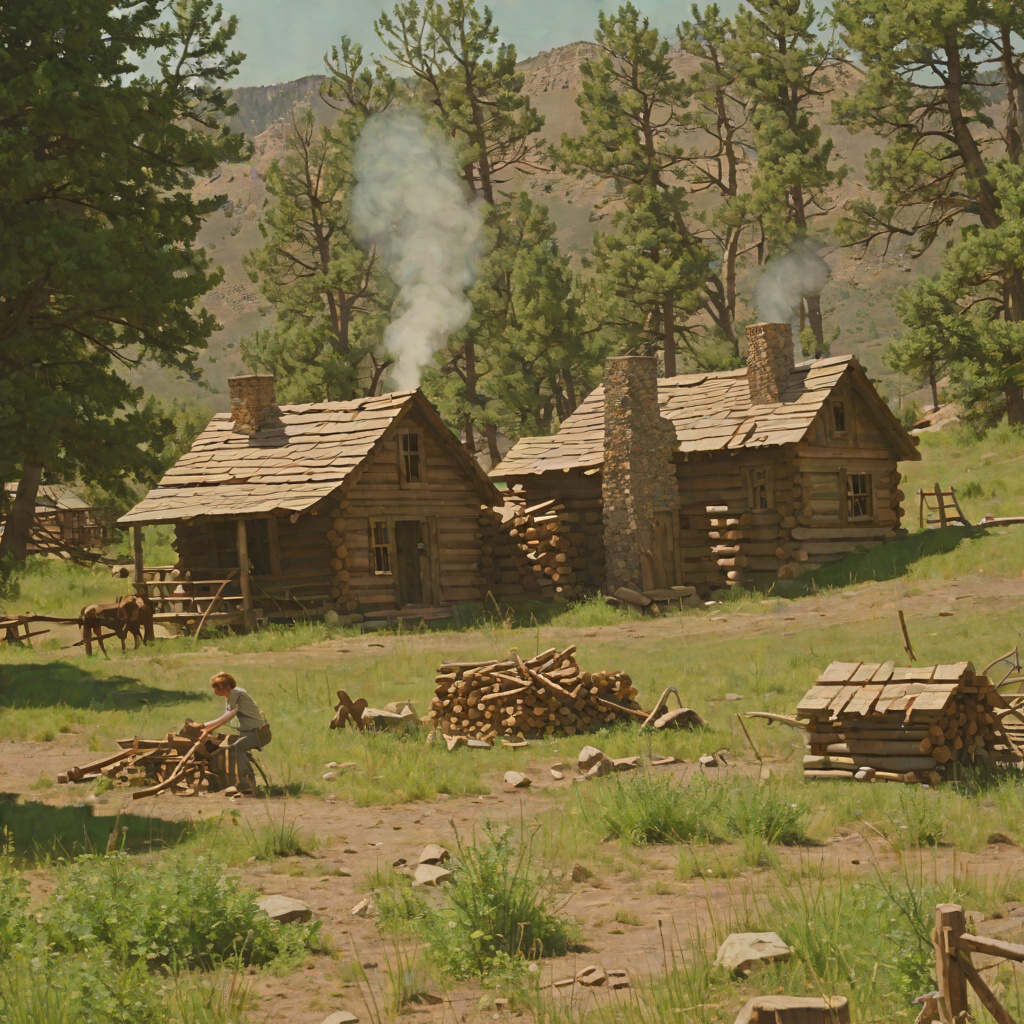
The axe's first great task begins immediately upon the family's arrival at the creek near the Verdigris River. After Pa and Ma unload the wagon and cover their belongings with the canvas, Pa takes his axe and drives away to the creek to cut logs for their new house. This single act sets the entire settlement in motion. Day after day, Pa returns to the creek with his axe, and when he has enough logs, he measures the shape of the house on the ground by walking from side to side and front to back. He digs shallow trenches along two sides and rolls two big logs into them, then places two strong logs across the first two to make a square. With his axe he makes a deep, wide cut near the end of each log, and the four logs fit together at these cuts, forming the foundation that can hold up the new house. The axe is not merely a cutting tool here; it is the instrument of precise joinery, the means by which Pa's mental blueprint becomes physical reality.
Crafting the Door and the Fireplace
The axe continues its work as the house takes shape. After the wolf scare, when Pa resolves that he wants more than a quilt between his family and the wolves, he takes the horses and his axe to get wood for a door. Laura helps him, handing him his saw, which he uses to cut the logs at the ends, while with his axe he makes nice, straight boards from the logs. He lays the long boards on the ground and fastens shorter boards across them to make the door, then builds a door frame and hinges. Laura stands against the door to hold it up while Pa fastens the hinges to the frame, and when it is finished, Pa declares, "Now we're all safe!" The axe has produced not just shelter but security. Later, the axe is essential to the construction of the fireplace. After Pa has cleared grass in a square outside the house wall and laid rows of rocks with mud, he goes into the house and, with his axe and saw, cuts a hole in the wall, completing the fireplace that allows Ma to cook inside. The axe thus enables the domestic heart of the home, the hearth around which the family gathers.
The Axe and the Roof
The axe's most ambitious project is the roof. Pa takes the canvas off the top of the house and, for days, carries logs from the creeks and cuts them into long, thin boards with his axe. The boards lie all around the house until Pa reaches down, pulls up a board, and nails it across the rafters, working his way to the top until the roof is done and rain will never get in. He then makes a floor with beautiful hard wood. Ma's praise, "You've done a wonderful job, Charles," acknowledges the culmination of the axe's labor. The house is now complete, a fully realized home on the prairie, and every beam, board, and plank bears the mark of the axe.
The Axe in Daily Life and Hunting
The axe is not only a building tool but also a companion to Pa's hunting and provisioning. As wild animals wear their thick winter fur, Pa goes hunting every day, catching small animals and shooting large ones for their fur. He carefully puts the skins outside to dry in the sun, and in the evenings he pulls the dry skins between his hands to make them soft, building the bundle of furs he will trade next spring in Independence. While the axe is not directly used in the hunting itself, it is part of the same cycle of self-sufficiency, the tool that maintains the homestead while Pa ranges across the prairie. The axe also appears in the context of the family's preparations for departure, when Pa and Ma pack the wagon with clothes, food, and dishes, leaving behind the plough as the one thing they cannot take. The axe, too, is left behind, its work finished, its purpose fulfilled.
The Axe and the Prairie Fire
The axe's role in the family's survival is most dramatically tested during the prairie fire. When Pa spots the great black clouds in the south and shouts "Prairie fire!", the family scrambles to prepare. Pa puts the cows in the barn and, with Pet and Patty still pulling the plough, runs behind them, making a long trench all the way around three sides of the house. The plough, not the axe, is the tool that saves the house from the flames, but the axe's earlier labor in building the house and the stable is what makes the defense meaningful. The fire passes, and the house stands, a testament to the axe's enduring work.
The Axe and the Departure
The axe's story ends not with triumph but with abandonment. When Mr Edwards and Mr Scott tell Pa that the government in Washington is sending soldiers to make the settlers leave Indian Territory, Pa refuses to wait. "I won't stay here until the soldiers take me away like a criminal," he declares. "We're going now!" The family packs the wagon, leaving behind the plough, and as Pet and Patty walk away from the little house on the prairie, the axe is left with it. The house that the axe built, the door it crafted, the fireplace it cut, and the roof it shaped all stand empty, a monument to a year of labor that the government's order renders void. The axe, once the symbol of Pa's power to create a home from the wilderness, becomes the symbol of that home's fragility and the family's displacement. Pa's cheerful words, "What's a year? We have all the time in the world," cannot hide the fact that the axe's work, however skilled, could not secure a permanent place on the prairie.